











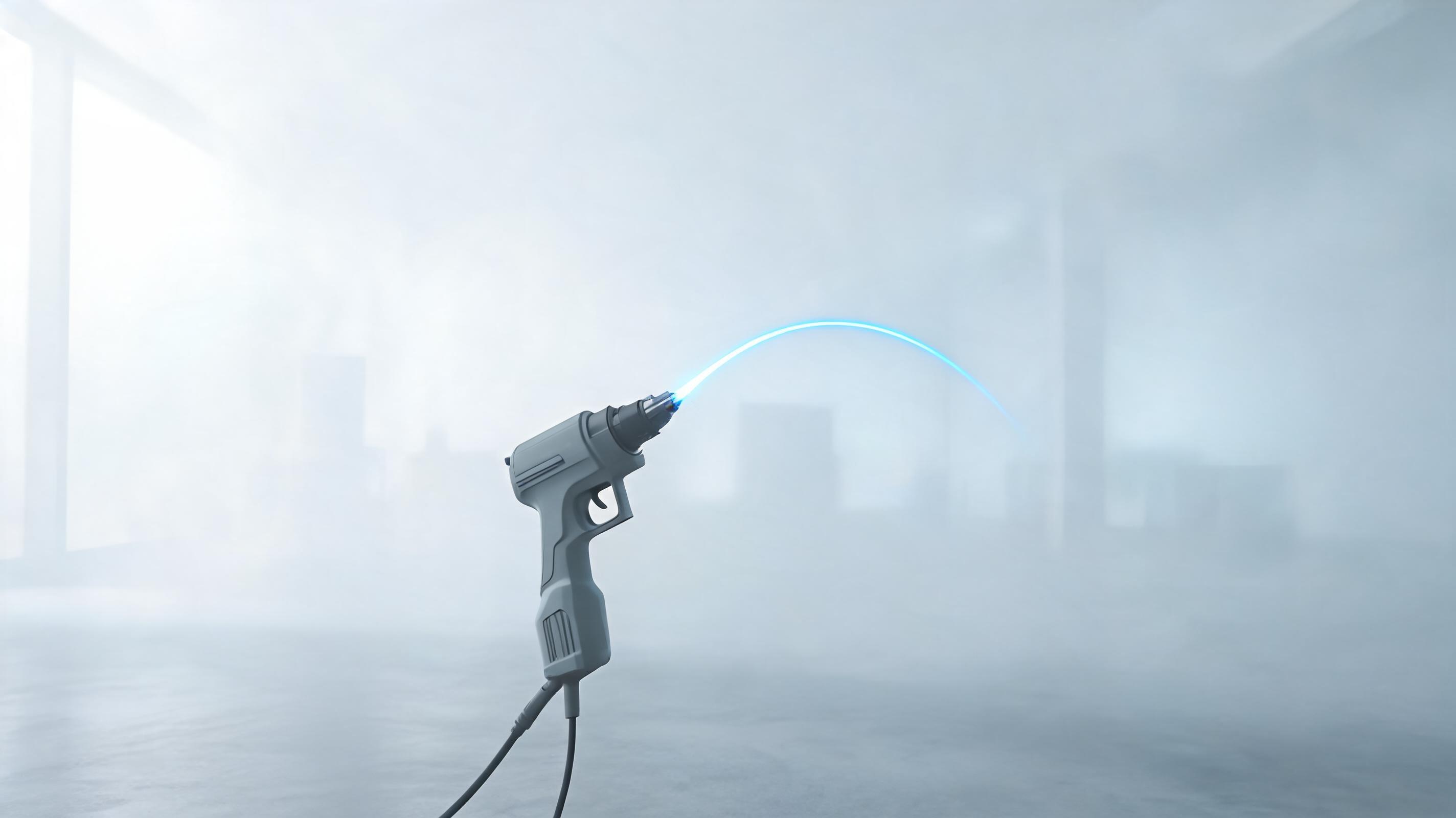
China's handheld laser welding sector has crossed a symbolic threshold: what began in 2017 with the world's first handheld laser welder, built in Shenzhen, has matured into a full product category where Chinese vendors now define the global standard. The latest proof point is the Huanri Laser K-series, which introduces what the company calls "laser swing welding technology" — a genuine breakthrough in a field that had been stuck with straight, narrow weld seams.
The swing-welding problem
Traditional laser welding has one stubborn limitation: the beam travels in a straight line, producing narrow seams. Human welders using TIG or MIG torches, by contrast, can move the arc side to side to cover wide seams, irregular joints and non-standard geometries — a manual skill that takes years to master. Until now, laser welding guns were too long and heavy to let operators reproduce that swinging motion, which confined laser welding to a narrower set of joint types.
The K-series attacks this from two directions. First, the upcoming new K1 welding gun is half the length of current laser welding guns and weighs only about 290 grams, finally making a laser torch light enough to be manipulated the way a welder would swing a TIG or MIG gun. Second — and more fundamentally — the technology replaces the welder's hard-to-learn hand technique with scanner-mirror oscillation unique to laser welding: a galvanometer dynamically swings the beam, controlling spot size, shape and energy distribution. This substitutes controllable optics for difficult manual skills, lowering the barrier to high-quality welding while preserving laser welding's advantages in depth-to-width ratio, speed and quality. The result is true all-scenario welding coverage, including wide and irregular seams that were previously out of reach for lasers.
Solving spatter: "drain" and "block"
Welding gun reliability is the industry's other pain point — by industry estimates, roughly 80% of handheld laser welding quality problems trace back to the gun: dust and spatter contaminating protective lenses, back-burn damage to the optical path, and misalignment after drops. The Huanri K-series tackles this with a two-pronged strategy. On the "drain" side, the series uses the industry's only "CONE spot" technology, which optimizes the laser energy distribution so heating is uniform rather than concentrated at a single point — reducing rapid vaporization and spatter at the source and stabilizing the molten pool. The K1M accordingly achieved the world's lowest spatter radius. On the "block" side, a three-layer "block, stick, absorb" defense protects the gun: a metal filter mesh at the gun head stops spatter from entering the barrel, internal adhesive catches non-metallic powder that slips through, and magnets capture metallic dust — achieving 100% isolation between the protective lens and welding spatter.
Market context: a Chinese-led boom
The K-series launch lands in a market growing at remarkable speed. Global handheld laser welding sales have grown twelve-fold in seven years, driven by fiber laser prices that have plunged to roughly 6,500–7,000 RMB per kilowatt. By 2024 the global market reached 6.4 billion RMB in sales, with China holding a dominant 71% share — five times North America's and nine times Europe's. Penetration versus traditional arc welding remains low (about 4.4% by unit output in 2024), leaving enormous replacement headroom: projections see global handheld laser welder sales reaching 860,000 units by 2030 and approaching or exceeding one million units by 2031, with over 70% of that market concentrated in China. By 2031 the global handheld laser market is expected to reach 17.6 billion RMB.
The report containing this analysis, published by Chuangxin Laser jointly with Professor Zhao Haiyan of Tsinghua University at a China Welding Association seminar, also identifies 1000–2000W as the mainstream power band (63.2% of 2024 sales) and predicts that air-cooled designs will progressively displace water cooling below 2000W on weight, cost and maintainability, while efficient refrigerant cooling takes over the medium/high-power segment above 2000W.
Safety as a precondition
The report is blunt about safety: handheld laser welding equipment's invisible reflected light is an often-neglected hazard, and the industry must build hardware safeguards (contact-based safety circuits that only allow lasing when the torch touches the workpiece), personal-plus-engineering protection systems (laser safety glasses, enclosed protective rooms, ventilation), and certified, tiered operator training. Huanri products are currently the only handheld laser welders in China to hold German safety certification qualifying them for EU sale, and the company is leading China's first group standard for handheld laser welding safety procedures — a reminder that as Chinese vendors push from "China-made" to "China-created," safety engineering is becoming part of the competitive proposition, not an optional cost.
With products like the K-series, Chinese handheld laser welding is moving from cost leadership to definition leadership — setting the form factor, process envelope and standards that the rest of the global market follows.