











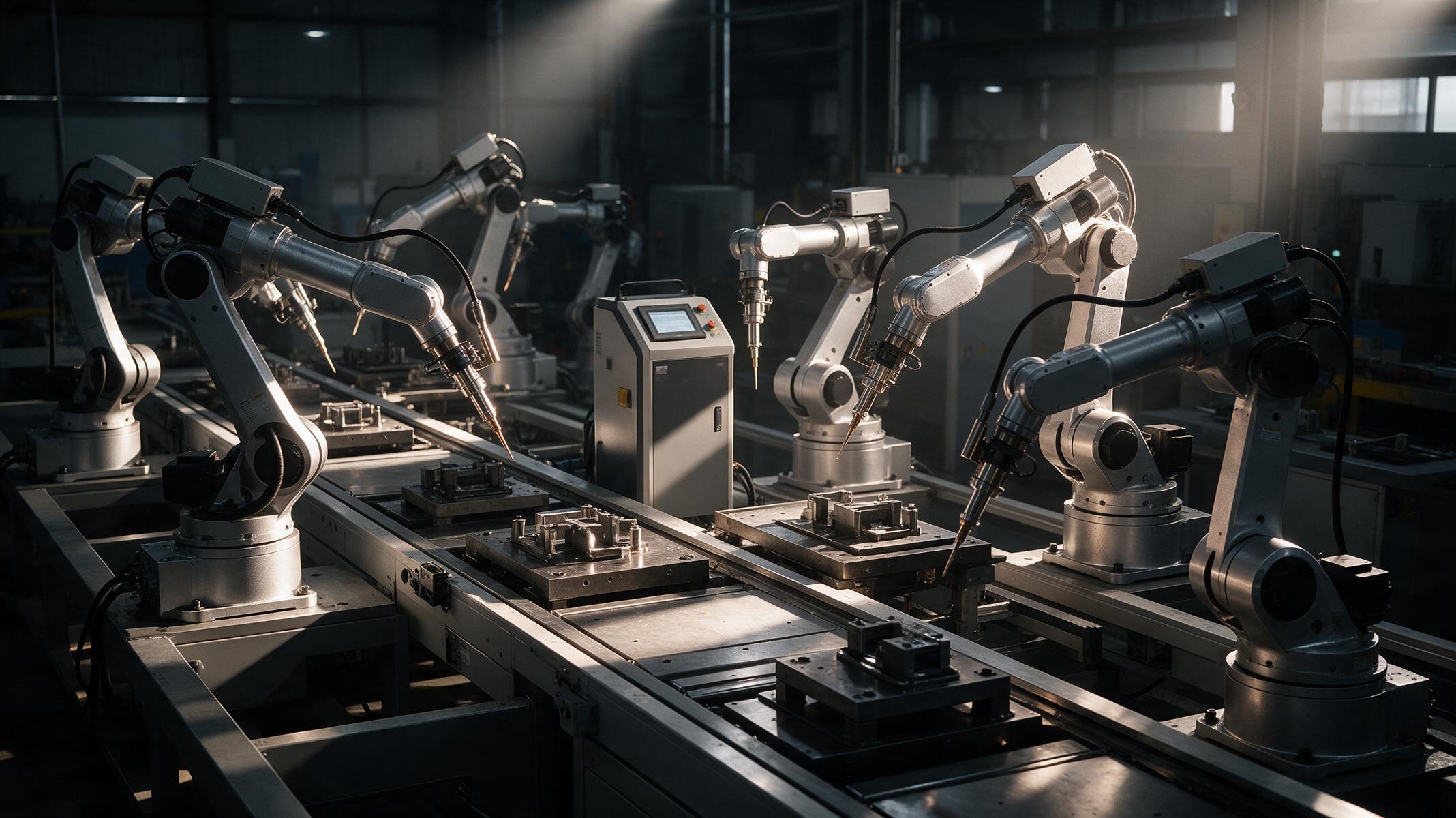
An equipment manufacturer in Hebei, China has announced that a welding production line built around a domestically developed robotic laser welding subsystem is now officially in operation. The line is used primarily for welding galvanized steel sheet, combining laser processing with robot manipulation to offer manufacturers a practical path to automation. The core welding subsystem comes from Shenzhen-based Baochen Xin Laser, a domestic supplier of fiber laser sources and welding optics.
Why galvanized steel is hard to weld
Galvanized sheet is widely used in sheet-metal fabrication, hardware manufacturing, automotive production and heavy machinery, but it poses a specific challenge for laser welding: zinc boils at about 906°C, far below the melting point of iron at 1,538°C. During welding the zinc coating vaporizes readily, and the escaping vapor commonly causes spatter and porosity that degrade weld quality. This metallurgical mismatch has long made high-quality laser welding of galvanized parts a difficult process window to hit.
How the Baochen Xin system addresses it
The deployed subsystem pairs Baochen Xin's self-developed continuous-wave fiber laser with a dual-swing wobble welding head and an intelligent control system. Through precise optimization of the optical path and power control, the line in Hebei suppresses spatter effectively and produces uniform, porosity-free seams that require no post-weld grinding, raising product yield. The high speed of laser welding combined with the robot's fast cycle times lifts per-station productivity compared with manual welding, while the small heat-affected zone keeps distortion of the galvanized sheet negligible — eliminating a separate straightening step and lowering overall manufacturing cost.
According to line operators, all welding parameters can be set from a single control screen, and ordinary workers can be trained to run the line after only a short onboarding period — a meaningful help in an industry facing a persistent shortage of skilled welders. The Hebei manufacturer also credited Baochen Xin's engineering team with deep technical support from initial consultation through commissioning, which shortened the line's upgrade timeline.
A standardized, "plug-and-weld" unit
Baochen Xin positions the subsystem as a standardized solution: an integrated design that forms a plug-and-play intelligent welding cell with high integration, a rich process library, strong safety features and a choice of specialized laser sources. On the hardware side, the system uses a high-performance laser with either a fixed or an oscillating (wobble) welding head, both optically optimized. It supports the Modbus-RTU protocol, allowing parameters to be written remotely through the robot teach pendant, and offers multiple control modes so operators can configure every welding parameter from a touchscreen. For different materials and thicknesses, Baochen Xin supplies selection guides and process packages that quickly locate a usable welding window for either keyhole (deep penetration) or conduction-mode welding; parameters controlling penetration depth and bead width can be tuned and stored for recall. Operators can perform all parameter setting and process debugging from a centralized controller outside the robot's working envelope.
The standard light source is the M-series welding-grade unit, with electro-optical conversion efficiency of up to 43 percent and long-term output stability of ±2 percent. Optional P-series lasers add power compensation with microsecond-level response and multiple protection functions. For the most demanding bead-forming requirements, an optional ring-spot laser uses dual-beam welding to suppress spatter further.
Product family and roadmap
The subsystem is aimed at welding integrators, retrofit specialists and end users, with applications spanning sheet-metal shops, hardware manufacturing, heavy machinery, automotive, new energy and 3C electronics; it has already been deployed at multiple customer sites. Beyond the standard configuration, Baochen Xin offers split, integrated, custom and mobile welding platform variants. Its XR1500 mobile welding platform — launched at the Munich Shanghai Light Expo — targets small-batch, high-mix welding at unfixed workstations: it combines an air-cooled laser, an intelligent dual-swing welding head and a mobile cart platform, supports rapid collaborative-robot deployment, and needs no complex installation, making it usable outdoors, at height or in tight corners of a workshop. The company says it will continue deepening its "laser + robot" innovation to explore automated welding across more industrial scenarios.