











At the 26th China International Industry Fair (CIIF), held October 12-16 at the National Exhibition and Convention Center in Shanghai, the robotics industry's most striking shift was on display: the era of humanoid robots performing song-and-dance routines and sand-art shows is clearly fading, and the competition has moved down to the fundamentals - world models, industrial embodied-AI foundation models, dexterous hands, force-controlled joints, and unified scheduling systems.
From performances to production metrics
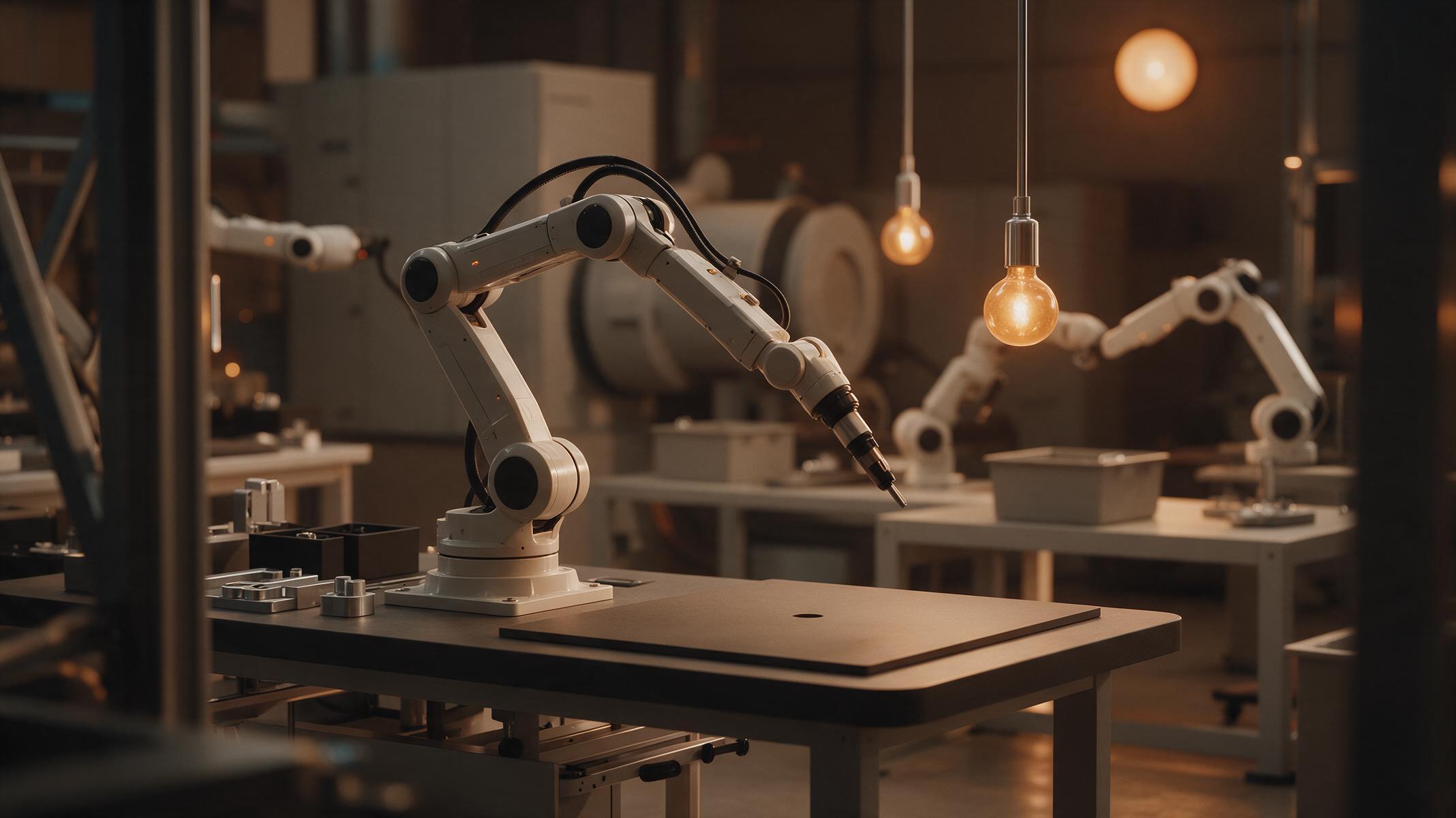
The fair's robotics show, themed "Embodied Industry, Smart Leadership of the Future," for the first time set up a dedicated embodied-intelligence zone linked with the main exhibition halls. At the center of the stands were life-like workstations replicating real workshops: material handling, 3C electronics assembly, auto-parts machining, and optical-module inspection. Wheeled humanoid robots worked alongside multiple robotic arms to transfer materials and complete assemblies - no point-by-point teaching by engineers, just natural-language instructions from operators.
Reporters at the show described the most tangible change: the industry's core focus is shifting from performance to output, delivery, and deployment in real scenarios. Exhibiting companies said downstream manufacturing customers increasingly judge solutions by operating stability, maintenance cost, and full-lifecycle return on investment. Industrial robots remain the short-term revenue mainstay; humanoid robots are mostly in factory pilots, used to accumulate data and refine processes, with the tipping point for large-scale adoption likely one to two years away.
"Business cards still aren't enough this year," several booth staff said - many visitors, after seeing a demo, immediately arranged factory visits to inspect pilot lines already in production. Visitors no longer care about flashy demos; they open with hard questions about continuous-run capability, failure rates, retrofit timelines, and labor-substitution results. One food-industry buyer, for example, asked whether a robot-plus-vision system could perform online egg-grading and crack detection that human inspectors struggle to sustain, and what budget and timeline such a retrofit would need.
Welding on the show floor
The trend reached the welding exhibits directly. At one booth, a cantilever-mounted robotic arm continuously adjusted its posture to complete multi-angle, continuous welding demonstrations, while Aishi Da (Astra) grouped robotic manufacturing with multi-scenario applications - a flexible machining line built around orange industrial arms paired with machine tools and pallets. ABB, Fanuc, KUKA, and Yaskawa all showcased complete body-in-white welding, painting, and final-assembly automation systems, anchoring their pitches in real production scenarios rather than standalone machines.
Physical AI, not a bolt-on chatbot
The show gathered more than 350 brands from 13 countries and over 300 product debuts. Exhibitors stressed that "physical AI" is not simply attaching a large language model to a robot: the point is for robots to autonomously recognize material deviations in a real physical environment, plan their own paths, and recover from anomalies - matching the multi-SKU, small-batch demands of flexible manufacturing. Unified scheduling of heterogeneous robots was a highlight: a single agent system simultaneously coordinating robotic arms, mobile robots, and wheeled humanoids.
Siemens presented an end-to-end embodied-AI offering covering R&D, production, final assembly, and on-site deployment, and opened six "robot entering the factory" scenarios. Pei Anzi, executive vice president of Siemens Digital Industries Automation and head of Siemens Digital Industries in Greater China, said the key challenge for humanoids entering factories is meeting industrial-grade requirements - stability, response speed, and payload capacity. Siemens does not build humanoid robots itself; instead it leverages industrial software, automation, digital twins, and production scheduling to help robot companies design, manufacture, and mass-produce, and to push robots into real production flows.
One engineer from a Yangtze River Delta systems integrator, a regular CIIF visitor, summed it up: concept hype has cooled while production-ready solutions multiplied. Customers are no longer asking whether a robot can dance or walk - they want to know whether it can hold up doing real work on a factory floor.