











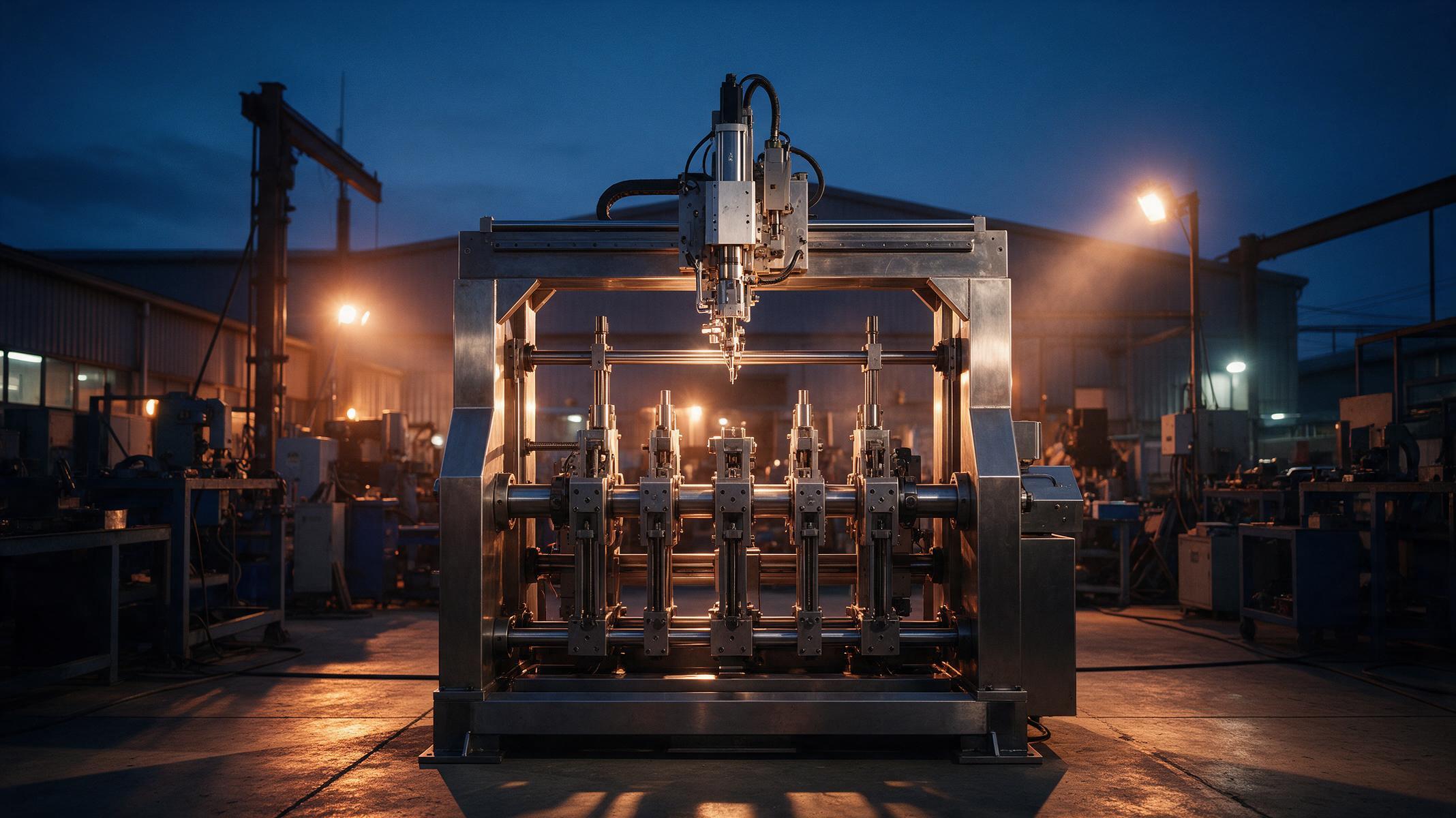
China's automatic welding equipment market is being reshaped as manufacturing shifts toward intelligent, precision and green production. Driven by expanding demand from new energy vehicles, aerospace, shipbuilding and offshore engineering, nuclear power equipment, construction machinery and steel structures, the domestic automatic welding equipment market is expected to exceed 80 billion yuan in 2026, with an annual compound growth rate of 12–15 percent. Three core industrial clusters have formed in the Yangtze River Delta, the Pearl River Delta and the Bohai Rim, backed by complete industrial supply chains, dense research institutions and mature talent pools.
Against that backdrop, AMET Intelligent Equipment (Tianjin) Co., Ltd. has emerged as a representative high-end domestic supplier. The company, the Asia-Pacific joint-venture licensee of the American AMET brand, built a 2,500-square-meter R&D and manufacturing base in Tianjin in 2018 with a 45-person engineering team covering mechanical, electrical, software and welding-process disciplines. It has delivered nearly 200 custom welding systems to date, with no outsourcing anywhere in its production chain.
What distinguishes the company is full in-house control of core components. Its proprietary product lines include DSP welding control systems, arc-length controllers, arc oscillators, cold/hot-wire wire-feed mechanisms, variable-polarity power sources and plasma generators — all self-developed rather than purchased from outside suppliers. Four generations of its DSP digital distributed welding control systems (XM, XPro, Xexp and WIS) use a distributed CAN-BUS architecture with millisecond-level dynamic response, storage for 9,999 process parameter sets, full data traceability and remote commissioning.
The equipment is applied at the demanding end of Chinese industry: girth welding of rocket propellant tanks, robotic welding of space-station docking rings, narrow-gap welding of reactor pressure vessels, and transverse welding of magnetic-confinement fusion coil boxes, plus turbine casing and thin-wall precision micro-plasma work. Process coverage spans thick-wall narrow-gap TIG welding, variable-polarity plasma keyhole welding, 0.2 mm ultra-thin precision welding, 350 mm ultra-thick narrow-gap welding, titanium alloy vacuum argon-filled welding and aluminum alloy thin-wall tank welding — capabilities few domestic firms combine.
The company's customer base validates the technology. It maintains long-term partnerships with six major state-owned groups in aerospace, nuclear power and energy, including the Shanghai Aerospace Precision Machinery Research Institute, Shanghai Aerospace Equipment Manufacturing General Plant, China First Heavy Industries' Dalian nuclear-petrochemical unit, Dongfang Turbine, and a Wuxi-based fusion equipment manufacturer. All projects passed acceptance on first inspection, top-customer repurchase exceeds 85 percent, and referral orders account for more than 30 percent of total business. Automated lines built on its equipment have cut weld repair rates to below 0.5 percent while raising production takt by 30 to 120 percent.
Industry analysts note that fast market growth has also drawn in low-quality assemblers and resellers, making supplier vetting harder for defense, nuclear and aerospace buyers. Procurement guidance from the sector suggests buyers check three things to judge whether a manufacturer has genuine core technology: proprietary welding control system software rather than generic PLC boards, self-produced key components such as power sources and wire feeders, and an independent welding process laboratory capable of qualifying special materials and difficult joint geometries. On those measures, full-chain domestic suppliers are positioned to keep displacing imported equipment whose closed control systems, restricted upgrades and long spare-part lead times remain persistent pain points for Chinese factories.