











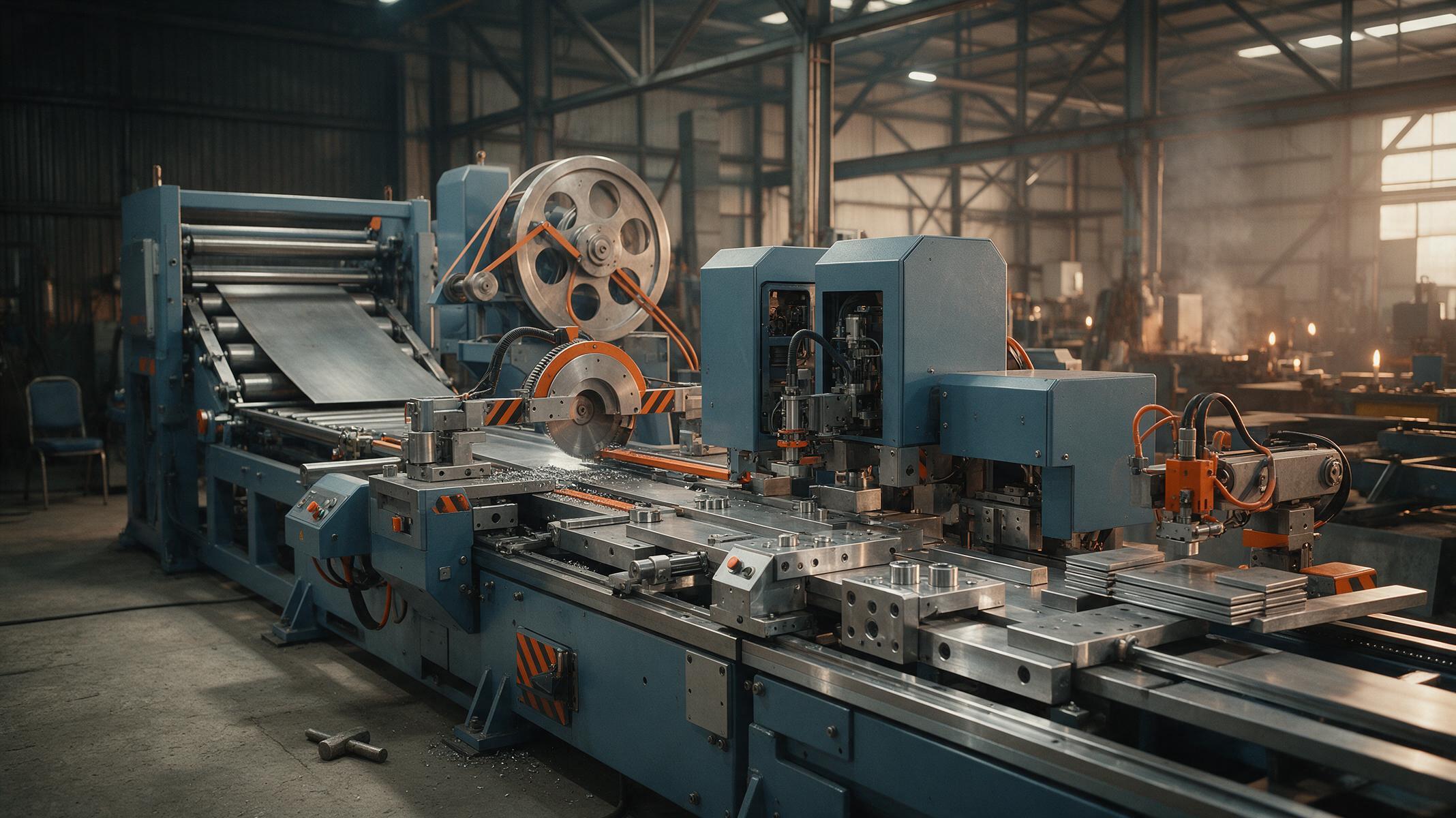
Shanghai Hugong Welding Group (stock code 603131) has introduced an integrated steel-plate online sampling machine that combines cutting, inkjet marking and sorting in a single pass, aimed at steel mills running continuous heat-treatment lines. The company says the system replaces a workflow that has traditionally required operators to manually locate plate edges, program cutting paths and re-enter marking information for every plate.
From production order to sorted sample, fully automatic
Once the machine automatically receives incoming-material and sampling information from a mill's L3/L2 production systems, it completes the whole workflow without manual steps: receiving production data, edge-scanning and positioning, generating cutting tasks, sampling and cutting, generating marking content, inkjet marking, and finally sorting samples and scrap into separate collection areas. The company emphasizes that no manual nesting, no manual programming, no repeated marking-data entry and no manual sorting are required — production data directly drives the equipment.
Automatic edge scanning handles off-position plate
Plates arriving on the roller conveyor can sit slightly off-position. The automatic edge-scanning system detects the plate's actual edges and position, then applies positioning corrections automatically, establishing accurate coordinates for the subsequent sampling cut. Even if incoming material drifts, operators do not need to re-measure or re-find edges — the plate is recognized the moment it arrives.
Cutting tasks driven by data, not by hand
After positioning, the CNC system generates and executes the sampling cut automatically based on the production information already received from the customer's L3/L2 systems. What plate arrives, what sample is taken and how it is cut are all decided by production data. The sampling task shifts from "programmed manually, then executed" to "issued as production information, then executed automatically," removing per-plate re-programming and manual marking-entry errors.
Automatic marking and sorting close the loop
After cutting, the machine automatically generates inkjet marking content — arrows, letters, thickness and steel grade identifiers — from the upstream production information and keeps it associated with the current sample. The system then sorts material by type: samples go to the sample collection area and scrap to the scrap area, with no worker needing to enter the cutting zone to identify, carry or classify pieces. From information receipt to sample collection, one online sampling task runs as a closed loop.
Built for real steel-mill conditions
The machine targets the online sampling station of steel heat-treatment lines rather than ordinary plate-cutting shops. It handles plate thicknesses of 4–50 mm, widths of 1,200–3,650 mm and lengths of 6,000–18,000 mm, with incoming material at up to 500°C, while tolerating mill scale on heat-treated plate surfaces and the high-temperature, dusty shop environment.
Reliability features include automatic edge scanning with drift correction, unified CNC control of positioning, piercing and cutting motion, automatic marking tied to production data, and a 360° anti-collision mechanism on the plasma cutting torch that stops motion immediately on any-direction impact to protect the torch and machine.
Why it matters
For steel producers, the company says the integrated machine reduces manual intervention, lowers data-entry errors, shortens the sampling cycle, strengthens sample traceability and raises overall line automation. The launch reflects a broader push among Chinese welding and cutting equipment makers to move heavy-industry material handling from standalone automated steps toward fully data-driven, closed-loop workflows that plug directly into factory information systems.