











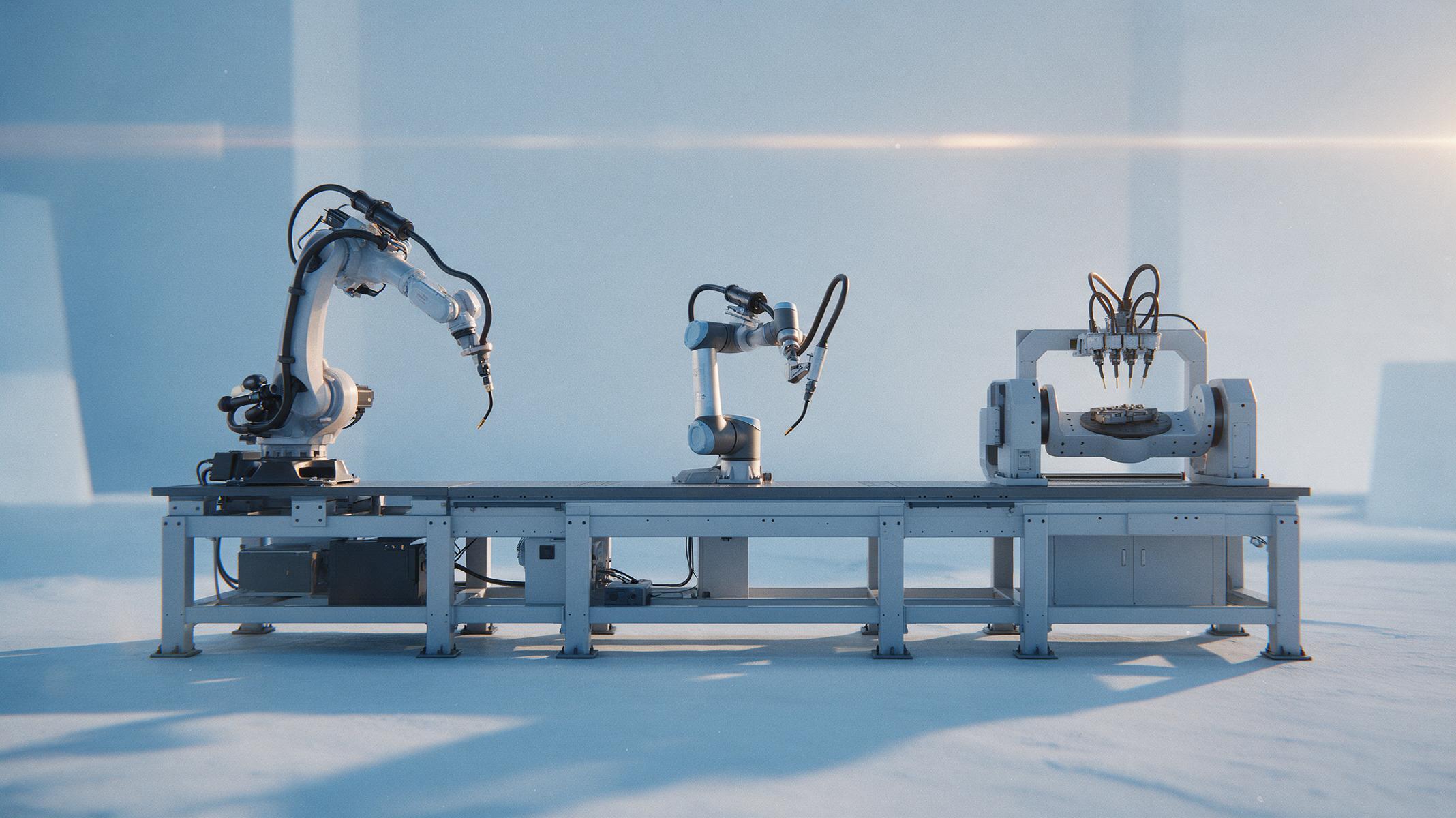
China's high-precision arc welding robot sector has reached a pivotal transition point — moving from simple automation toward true intelligence — according to a new 310-page industry research report from Shenzhen's Borui Industry Research Institute. The report identifies three converging technology directions that are redefining what welding robots can do.
The first breakthrough direction is the deep coupling of AI vision with weld seam tracking. Laser vision sensors combined with deep-learning algorithms now allow robots to automatically correct their welding path when workpieces arrive with dimensional deviations, eliminating one of the biggest causes of rework in automated production. The second is the rapid spread of teach-free programming: offline programming paired with AI-driven automatic path planning is dramatically lowering the operating barrier, so skilled technicians are no longer required for every changeover. The third is the arrival of embodied intelligence on the shop floor, where "hand-eye-brain" coordination lets the robot self-adapt welding parameters in real time. Together, these advances are pushing welding precision from the ±0.2 mm class toward ±0.08 mm and beyond.
The market backdrop explains the urgency. China's arc welding robot market reached 4.6 billion yuan in 2024 — 55.4% of the country's entire welding robot market — with sales of 35,100 arc welding units, up 22.7% year over year, far outpacing the industry average. The national welding robot market grew from 7 billion yuan in 2020 to 8.4 billion yuan in 2024 and is projected to hit 9.3 billion yuan in 2025. Globally, the broader welding robot market was valued at 10.23 billion dollars in 2024 and is forecast to reach 21.63 billion dollars by 2031, a compound annual growth rate of 11.4%.
Domestic substitution has entered deep water: Estun's 2025 revenue hit 4.888 billion yuan, up 21.9%, with its industrial robot shipments surpassing foreign brands in China for the first time and welding robot shipments expected to exceed 15,000 units. Siasun leads on AI vision and digital twin technology with over 90% supply-chain localization, while specialists such as CRP Kanopp, Qianjiang Robot and Kaierda hold differentiated niches. A structural driver remains the widening welder shortage — projected at 5 million workers in 2025 and 10 million by 2035 — with steel structures, shipbuilding and new-energy vehicles offering the biggest near-term demand. In steel structure plants, intelligent mobile welding robots have lifted welding quality by more than 55% and efficiency by more than 65% versus manual work.