











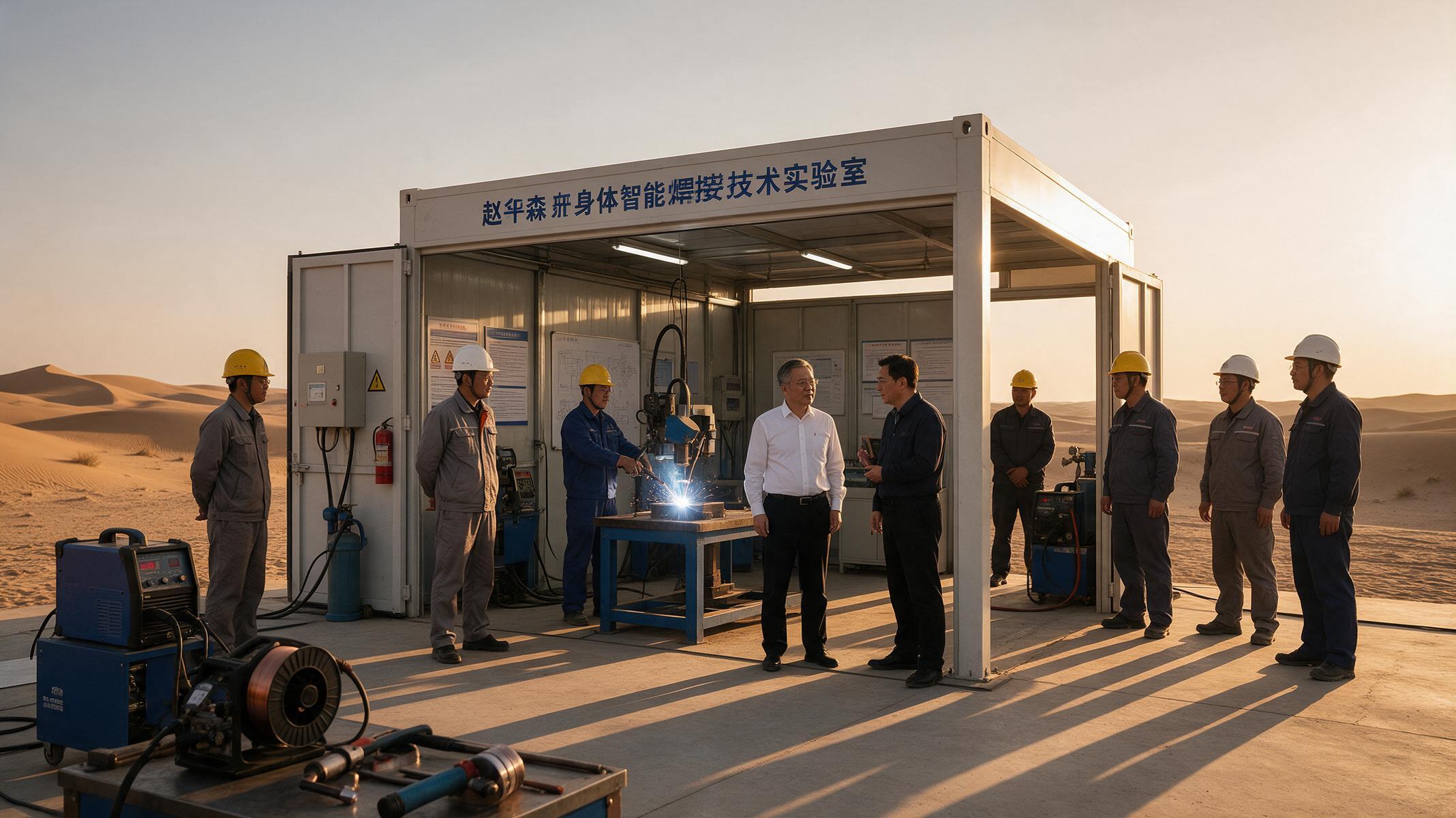
On October 27, 2026, the "Industrial Embodied Intelligence Welding and Inspection Technology Joint Laboratory," jointly established by the National Steel Structure Quality Inspection and Testing Center of MCC Construction Research Institute Co., Ltd. and Beijing Xiaoyu Zhizao Technology Co., Ltd., was officially unveiled in Beijing.
The National Steel Structure Quality Inspection and Testing Center is the only national-level quality inspection center in China's steel structure field. Its welding team has led the compilation of more than 100 standards, including the "Code for Welding of Steel Structures," and trained China's first WorldSkills welding gold medalist. The new laboratory will use national-level steel structure testing standards as its rigid benchmark, carrying out development of embodied-intelligence robot welding processes, sample inspection, and performance verification, while also cultivating versatile intelligent-welding talent for the steel structure industry — an attempt to connect the process development of intelligent equipment with authoritative national-level quality verification on a single platform.
"Embodied intelligence is developing rapidly, and precisely at a moment like this we must hold the line on quality," said Qiao Zhongliang, founder and CEO of Xiaoyu Zhizao, in his address. "Welding is not an ordinary process — every weld seam concerns engineering safety and human lives. Robots can weld seams faster, but if quality fails, the higher the efficiency, the greater the risk." He argued that traditional automation has hit a bottleneck when facing non-standardized problems, while embodied intelligence offers a new path: giving machines the human ability to learn. "From now on, embodied welding must not only raise efficiency but also raise quality to a higher level — every weld seam must be inspectable, traceable, and able to withstand measurement by the strictest ruler."
At the ceremony, Zhou Shuchun, head coach of China's national WorldSkills welding team, and Zhao Qiansen, the welding gold medalist at the 48th WorldSkills Competition, were appointed as expert committee members of the laboratory. Zhou, who has coached champions across four WorldSkills cycles, said: "The craftsmanship stays the same; what changes is the tool in hand. Chinese welders once welded the world — the next generation of welders will weld the world again, this time with Chinese robots." In September this year, Zhao Qiansen won gold at the 48th WorldSkills Competition in Shanghai with the highest score in the competition's history, bringing home China's fourth WorldSkills welding gold medal. "Our predecessors passed the baton to us," Zhao said. "We must carry it forward and win the gold medal of welding craftsmanship in the embodied-intelligence era."
Qiao Zhongliang said Xiaoyu Zhizao invited these master craftsmen so that craftsmanship, skill, and experience can be distilled into a inheritable process foundation, and the laboratory can train a new generation of welders who understand both process and AI. "This laboratory connects decades of deep accumulation in Chinese welding craftsmanship with the surging future of artificial intelligence."
Alongside the launch, Xiaoyu Zhizao disclosed its first customer case: in a workshop of the long-established state-owned enterprise Beipao Light Steel, 12 Xiaoyu future-generation robots have entered daily operation. According to data from August 2026, the workshop's monthly output has increased by 30% compared with before the retrofit, overall cost under equivalent welding quality has dropped by 49%, and a single machine produces roughly 90 meters of equivalent flat fillet welds per day. "The new productive force brought by embodied intelligence is no longer a proposition awaiting proof — it is a fact that has already happened," Qiao said. By taking over dangerous, arduous, and repetitive work, embodied intelligence in factories lets people stand in more dignified positions, he added.
Industry observers note that the establishment of the joint laboratory marks the deep integration of national-level authoritative testing capability with cutting-edge industrial embodied intelligence. It means that from data validation on customer production lines to standard-setting on a national testing platform, industrial embodied-intelligence welding is completing the key leap from "frontier technology concept" to "industrial-grade infrastructure" — pushing the intelligent upgrading of China's steel structure industry and contributing to the development of new productive forces.