











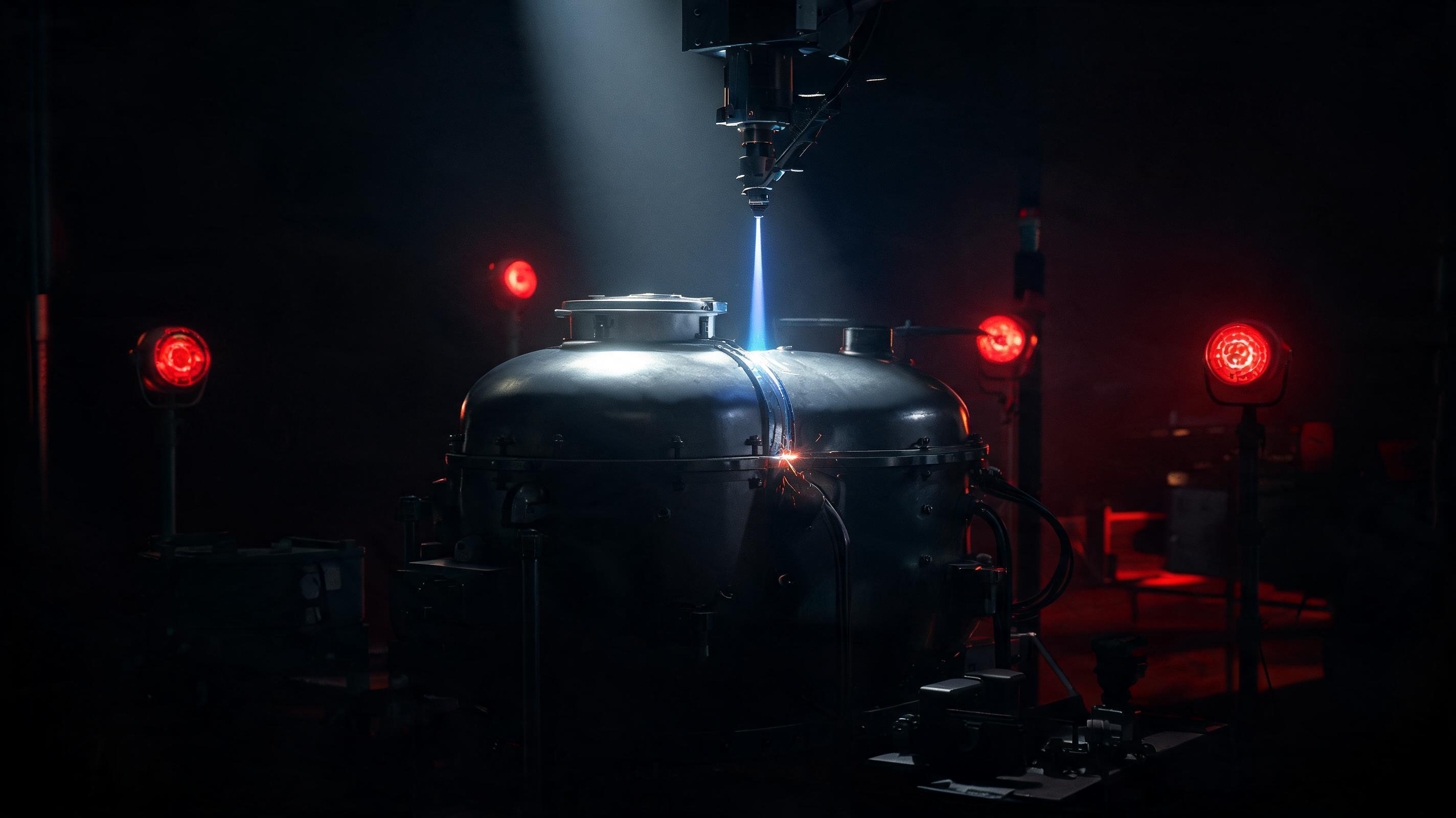
At the Jinshan, Shanghai workshop of Mikronika (Shanghai) Industrial Intelligence Technology Co., a quietly remarkable manufacturing scene is unfolding. Technicians are performing laser welding inside vacuum chambers using a process the company developed in-house, assisted by robotic arms and machine-vision positioning. The scene was opened up to reporters during a preview tour ahead of the China (Shanghai) International Technology Fair, where the company's solid-state battery equipment is being showcased.
According to Shao Zhushan, a technical specialist at the company, the laser welding process stands out for five properties: it is fast, dissipates heat quickly, causes no deformation, produces high-quality seams, and is highly efficient. It achieves single-sided welding with double-sided forming, and it is roughly ten times faster than manual welding. Perhaps most notably for vacuum work, welds come out clean enough to skip flaw-detection inspection entirely — a significant saving in a product category where every seam matters.
Welding is not the only step where automation has taken over. In the vacuum-box component machining area, the company has deployed an "automatic bending robot" that reads part drawings fed into a computer, then picks up, bends, and places the metal components of vacuum chambers on its own. Machining precision reaches the micron level, and the company reports the cell is both faster and safer than the manual alternative.
The context for this manufacturing capability is Mikronika's push into solid-state battery production equipment. The company — a leader in vacuum automation and vacuum intelligent equipment, with more than 170 patents and qualification as a supplier to CNNC (China National Nuclear Corporation) — has completed the pilot-line development for every process step of solid-state lithium battery manufacturing. It planned to open a fully automated solid-state battery pilot-line experimental platform in Songshan Lake, Dongguan, made available free of charge to researchers nationwide for process and materials validation.
Liu Xuefeng, the company executive leading the effort and dean of the Fengyuan Lithium Battery Equipment Research Institute, said the company has been targeting overseas battery markets since 2024, with progress in Australia and Russia, delivery of small experimental lines at the tens-of-millions RMB level, and negotiations underway for production lines at the hundred-million-RMB scale. Among the headline products is a lithium-metal cutting-and-stacking machine operated inside a glovebox — a key process step for solid-state batteries that overcomes lithium metal's extreme sensitivity to water and oxygen.
For the welding industry, the takeaway is a textbook case of process ownership: by pairing a proprietary laser welding process with robotic handling and vision guidance, a mid-size equipment maker has turned a traditionally labor-intensive, inspection-heavy fabrication step into a fast, deterministic, operator-light operation — and is leveraging that capability to compete in one of manufacturing's most demanding new markets.