











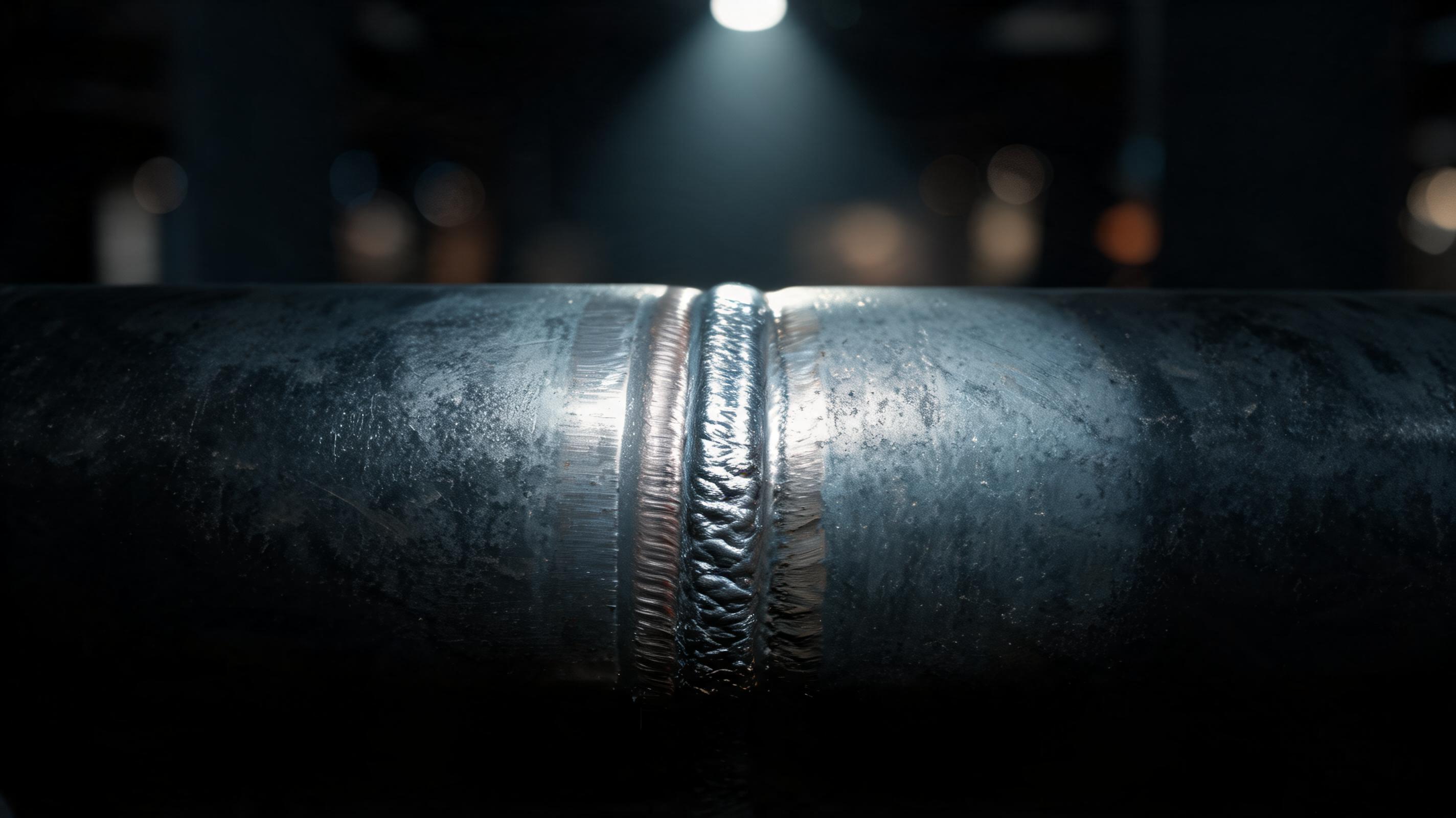
The Journal of Welding (HanJie XueBao), China's flagship peer-reviewed welding research journal, has posted a fresh batch of articles in its "priority publication" section — papers that have passed peer review and are citable by DOI while awaiting final volume and page assignment. The headline paper, accepted on October 27, 2026 (DOI: 10.12073/j.hjxb.20260727002), comes from Wang Haijie, Zheng Zhendan, Yan Shuai, Cheng Fangjie and colleagues, and tackles one of the most stubborn reliability problems in energy infrastructure: the girth welds that join sections of long-distance pipelines.
The problem: girth welds are the weak link
In long-distance pipelines, the connection between pipe sections is almost always the weakest link in the whole structure. High-grade steels such as X80 are strong, but the welding thermal cycle softens a narrow band of the heat-affected zone (HAZ), and that softened zone becomes the preferential site where failures start under load. Conventional research has attacked the problem metallurgically — adjusting chemistry and microstructure to recover strength in the softened band. This new paper takes a different route: geometric reinforcement.
The approach: low-heat-input flux-cored wire surfacing
Instead of trying to re-tune the microstructure, the team thickened the pipe end itself. Using a flux-cored arc welding process (FCAW-G) with deliberately low heat input of 12.48 kJ/cm, they deposited an 8 mm reinforcing layer of weld metal onto the girth-welded joint by surfacing. The idea is structural rather than metallurgical: compensate for the strength lost in the softened zone by adding load-bearing material around it.
The researchers then characterized the joints with optical microscopy, scanning electron microscopy, EBSD crystallographic mapping, hardness testing, digital image correlation (DIC) during tensile tests, and finite element simulation — a comprehensive toolkit spanning microstructure through full-scale mechanics.
The results: strength up 7.6%, and failures moved out of the danger zone
The outcome is a double-scale shift in where fractures occur:
- At the level of the thickened section, the surfacing reinforcement compensates for the strength loss of the softened HAZ and moves the fracture location away from the softened zone and into the thickened base metal. Ultimate tensile strength rises from 644 MPa to 693 MPa — a gain of about 7.6%.
- At the full-size pipeline scale, the process suppresses failure of the girth-welded joint itself, relocating fracture from the reinforced section to the unreinforced pipe body — precisely what a protective treatment is supposed to do.
The authors describe this as a dual-scale fracture-location transfer, and argue it significantly improves the service reliability of girth welded joints. Because the strategy is geometric rather than metallurgical, it offers a new "geometric strengthening" pathway for failure control of high-grade pipeline girth welds, complementary to the traditional metallurgical toolbox.
The wider context: a strong academic batch
The same priority-publication batch shows where Chinese welding research is heading. Other newly accepted papers cover data-driven multi-objective optimization of laser–arc hybrid welding parameters; transfer-learning-based prediction of penetration quality in high-pressure dry underwater GMAW; fatigue and ductile-brittle transition behavior of mismatched high-strength steel joints at low temperature; a review of welding consumable design for harsh service environments (cryogenic, hydrogen-containing, nuclear and high-temperature); twin-tungsten/wire-electrode indirect-arc additive manufacturing of 316L stainless steel achieving deposition rates up to 3.73 kg/h; and titanium alloy filler design for deep-sea equipment. Taken together, the batch underlines three persistent themes in Chinese welding academia: underwater and extreme-environment welding, additive manufacturing via arc processes, and AI/data-driven process control.