











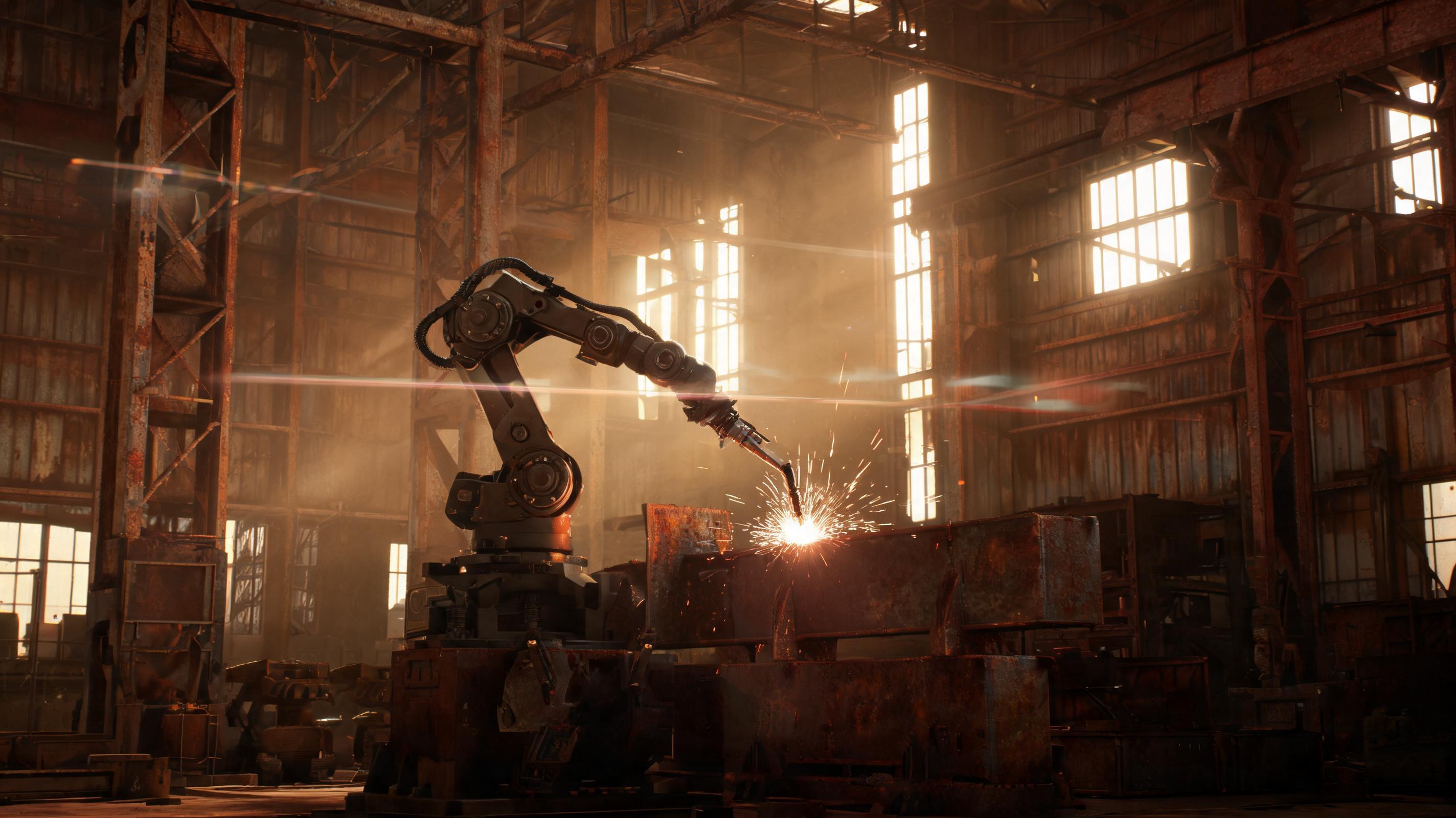
Zhouxiang, a Chinese welding automation manufacturer operating since 1991, presents itself as one of the few true welding robot manufacturers — as opposed to integrators that bolt FANUC, KUKA or Yaskawa arms onto a table. The company highlights 34 years in manufacturing, more than 200 patents (including 50+ invention patents), five robotic welding configurations, and deliveries to over 30 countries across Europe, North America, Southeast Asia and the Middle East.
Its argument is that welding automation demands control of the full engineering chain — robot kinematics, welding process parameters, vision systems, fixture design and software integration — because torch angle, travel speed, seam-tracking precision and fixturing must work together or the result is undercut, porosity or missed joints. A genuine manufacturer, the site argues, means a single point of accountability on the production floor rather than finger-pointing between robot, vision and power-source vendors.
The five system configurations
- Rail-mounted welding robot (long-seam production): extends robot reach along the full workpiece length, identifies seam positions and generates welding procedures without manual pendant teaching. Features Bochu long-range seam tracking, teachless welding from 3D CAD import, one-pass full-length seams and dual simultaneous workstations. Primary use: H-beams, stiffeners and plates.
- Gantry-type welding robot (wide-span): a single workshop portal frame covering up to 5,000 mm of weld width, with a large line-scan 3D vision system for drawing-free welding from point clouds. Handles straight, arc, curved and flat welds in bridge and ship fabrication.
- Cantilever-type welding robot (batch efficiency): a suspended overhead beam configuration that keeps floor space clear for crane loading — important for heavy batches of structural H-beams and diaphragm plates. Includes automatic torch cleaning and 3D point-cloud vision.
- Collaborative welding robot (cobot, shipbuilding specialist): a lightweight, single-person-portable unit with a magnetic base that clamps to steel decks without drilling, drag-and-teach programming, real-time arc tracking correction and no safety fencing required. Designed for tight shipyard compartments.
- Intelligent welding workstation (high-volume): a fixed cell with a hollow-structure arm, internal cable routing, dustproof and drip-proof construction and semi-automatic material handling for low-mix, high-volume production.
Bochu platform software intelligence
Zhouxiang's Bochu platform differentiates the systems from generic robot motion control through three capabilities. First, teachless welding: import Tekla, SolidWorks or UG 3D models directly, and the system identifies weld seam locations, matches process parameters to joint type and generates the welding program automatically. Second, adaptive seam tracking: a long-range 3D sensor measures the actual seam position ahead of the torch and corrects the path in real time, handling fit-up gaps of ±3 mm without manual intervention. Third, point cloud reconstruction: for workpieces without a 3D model, the line-scan vision system builds a point cloud, reconstructs the geometry and generates the weld path from raw scan data — no drawings needed.
Processes and target industries
The systems support MIG/MAG (GMAW) as the workhorse process for structural steel, TIG (GTAW) for thin-wall and critical joints, resistance spot welding for sheet metal, plasma welding for thick stainless and alloy plate, and laser welding where distortion must stay under 0.3 mm. Process changes are handled through a torch swap and parameter-set selection without reprogramming the robot path.
Target industries include steel structure fabrication (H-beams, box columns, plate girders, 6–40 mm fillet welding), shipbuilding (hull panels, bulkheads, deck sections, with cobots for confined compartment welding), and bridge construction. The company also cites an industry-university-research cooperation with a dozen Chinese universities in intelligent welding, 3D machine vision and adaptive process control, and publishes efficiency benchmarks claiming around +110% productivity and roughly a 15-month break-even on equipment investment for typical applications such as boiler panel membrane seams.
Why it matters
The Chinese welding robotics market is crowded with resellers and integrators, and Zhouxiang's positioning reflects a wider industry trend: vertical integration of welding intelligence — software, sensors and process knowledge — rather than assembly of imported arms. For buyers in steel fabrication, shipbuilding and bridge construction, the practical question is whether a vendor controls the seam-tracking and welding-process software stack, which is where most welding automation failures originate.