











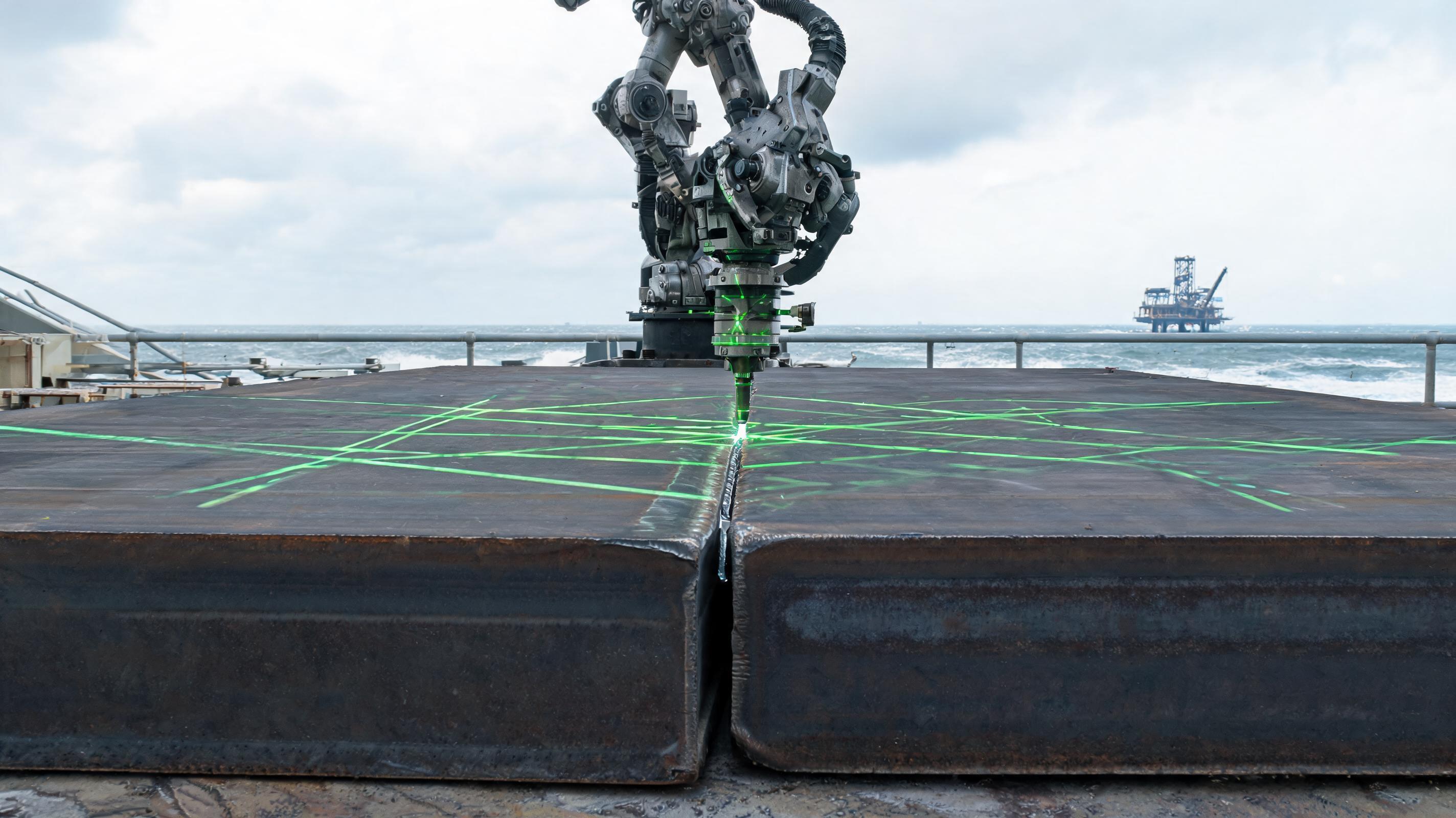
China's first batch of domestically developed flexible-manufacturing intelligent welding robots for offshore engineering applications has officially entered industrial service, marking a significant step in the country's push to replace imported high-end welding equipment in the demanding marine engineering sector.
Large offshore structures — oil and gas platforms, deep-water jacket foundations — present welders with confined spaces, complex geometry and tight precision tolerances. Traditional manual welding in these environments is physically punishing, high-risk, and difficult to scale to the exacting standards of deep-sea engineering. For years, high-end intelligent welding equipment for these applications depended on imports.
Fully Homegrown, End to End
The intelligent welding robot system now in service was developed in-house by Offshore Oil Engineering Co. (COOEC), the engineering arm of CNOOC. After completing overall system integration in August of last year, the platform went through ten months of on-site commissioning and engineering validation, with every performance metric meeting its specification before large-scale industrial deployment.
The system was purpose-built for high-difficulty, custom welding scenarios such as node joints on offshore oil and gas platform modules and reinforcing rings on deep-water jackets. It carries a design life of 20 years and a maximum load capacity of 30 tonnes. Crucially, the core software and process database are 100% localized, removing the dependency on foreign technology that has long defined this niche.
Cracking the Industry's Hard Problems
During development, the team cleared several long-standing technical bottlenecks: identification of variable-cross-section weld grooves, planning of complex welding paths, and adaptive adjustment of process parameters in real time. More than ten innovations were put into practice, including AI-based weld-seam visual recognition, 3D laser-assisted intelligent fit-up, and intelligent multi-layer, multi-pass pass-sequence welding.
The robot supports one-touch fully automatic operation and can autonomously correct welding trajectory deviation and perform intelligent backing passes, fitting precisely into cramped, complex welding spaces where manual reach and consistent precision have always fallen short.
Big Gains in Efficiency and Quality
To make the equipment robust across varied field conditions, the R&D team ran nearly 1,000 welding trials and built a proprietary process database of more than 500 entries covering electrical parameters, weaving parameters and pass-sequencing logic — a key contributor to stability during continuous operation.
The results: the robot welds steel up to 70 millimetres thick with a first-pass weld acceptance rate above 98%, and raises overall operational efficiency by more than 40% compared with conventional manual welding. It also removes welders from high-risk elevated and confined-space work, a persistent safety concern in offshore construction.
The deployment gives Chinese offshore oil and gas projects a domestically controlled, intelligent and highly efficient welding capability, and signals that China's smart-welding equipment chain — from sensing and path planning to process databases — has matured to the point of competing at the top end of the marine engineering market.