











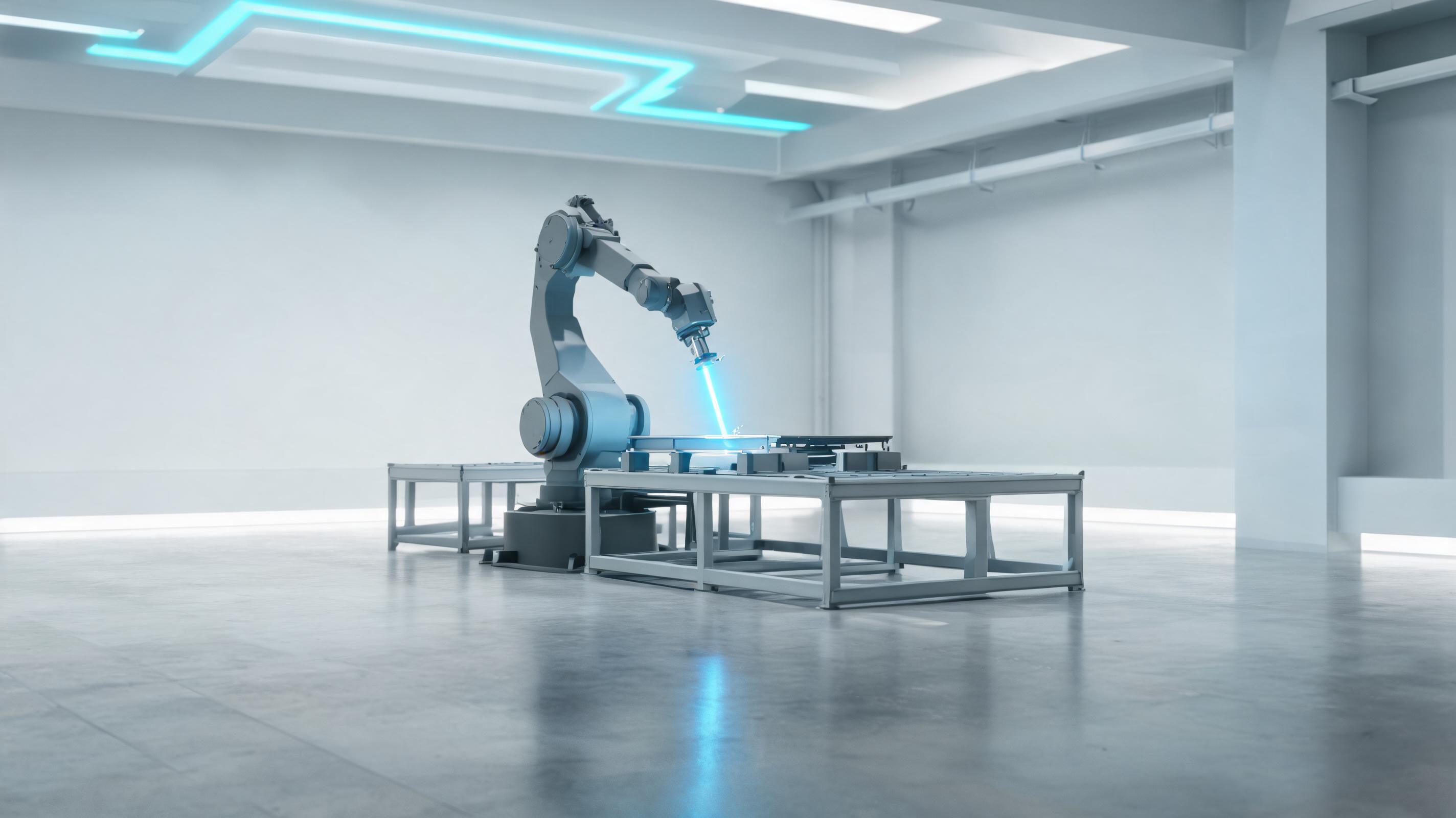
An equipment manufacturer in Hebei province has announced that its welding production line, built around a domestically developed robot laser welding subsystem from Shenzhen Baochenxin Laser, is now officially in operation. The line is used primarily for galvanized steel sheet welding, combining laser and robot technology to give manufacturers an automation upgrade path.
Galvanized sheet is widely used in sheet-metal fabrication, hardware manufacturing, automotive production and heavy machinery, but its laser welding poses a distinctive process challenge: zinc boils at 906°C, far below iron's melting point of 1538°C, so the zinc coating vaporizes during welding and easily triggers spatter and porosity that degrade weld quality. To address this, Baochenxin supplied a robot welding subsystem equipped with its own continuous-wave fiber laser, a dual-swing wobble welding head, and an intelligent control system. In production, precision optical-path optimization and power control effectively suppressed spatter and produced uniform, porosity-free seams that need no post-weld grinding, raising the product yield. With fast laser welding paired to high-tempo robot motion, single-station throughput rose well above manual welding, and the small heat-affected zone left galvanized sheet with negligible distortion, eliminating the straightening step and cutting overall manufacturing cost. Operators reported that all welding parameters can be set from a single control screen, and ordinary workers can start the line after short training, easing the shortage of skilled welders.
Baochenxin describes the subsystem as a standardized, integrally designed "plug-and-play" intelligent welding unit with high integration, a rich process library, strong safety features, and diversified professional light-source options. The hardware pairs a high-performance laser with either a fixed or a wobble welding head, optically optimized for the job. The system supports the Modbus-RTU protocol and can receive parameters written remotely through the robot teach pendant, supporting varied control modes; operators set every welding parameter from a touchscreen. For different materials and thicknesses, Baochenxin provides welding selection guides and process packages that quickly locate the welding window for keyhole or conduction welding, with adjustable penetration and bead width that can be stored and recalled. Operators never need to enter the robot's work area — parameters and process tuning are handled from a centralized controller in the safe zone. The standard configuration carries the M-series welding-grade light source with electro-optical conversion efficiency up to 43% and long-term output stability within ±2%; the optional P-series laser adds power compensation with microsecond-level switching response and multiple protection functions, while the optional ring-spot laser uses dual-beam welding to suppress spatter in applications with the most demanding weld-forming requirements.
The company says the subsystem was built for welding integrators, retrofit shops and end users, and is already deployed at multiple customer sites across sheet-metal processing, hardware, heavy machinery, automotive, new energy and 3C electronics. Baochenxin has also released the subsystem in split, integrated, custom and mobile-platform formats. Its XR1500 mobile welding platform, launched at the Munich Shanghai Light Expo, targets small-batch, high-variety welding at non-fixed stations by combining an air-cooled laser, an intelligent dual-swing welding head and a mobile cart, supporting rapid collaborative-robot deployment with no complex installation — suitable for field, elevated and workshop-corner scenarios. The company says it will keep deepening its "laser + robot" innovation and exploring automated welding applications across industrial scenarios.