











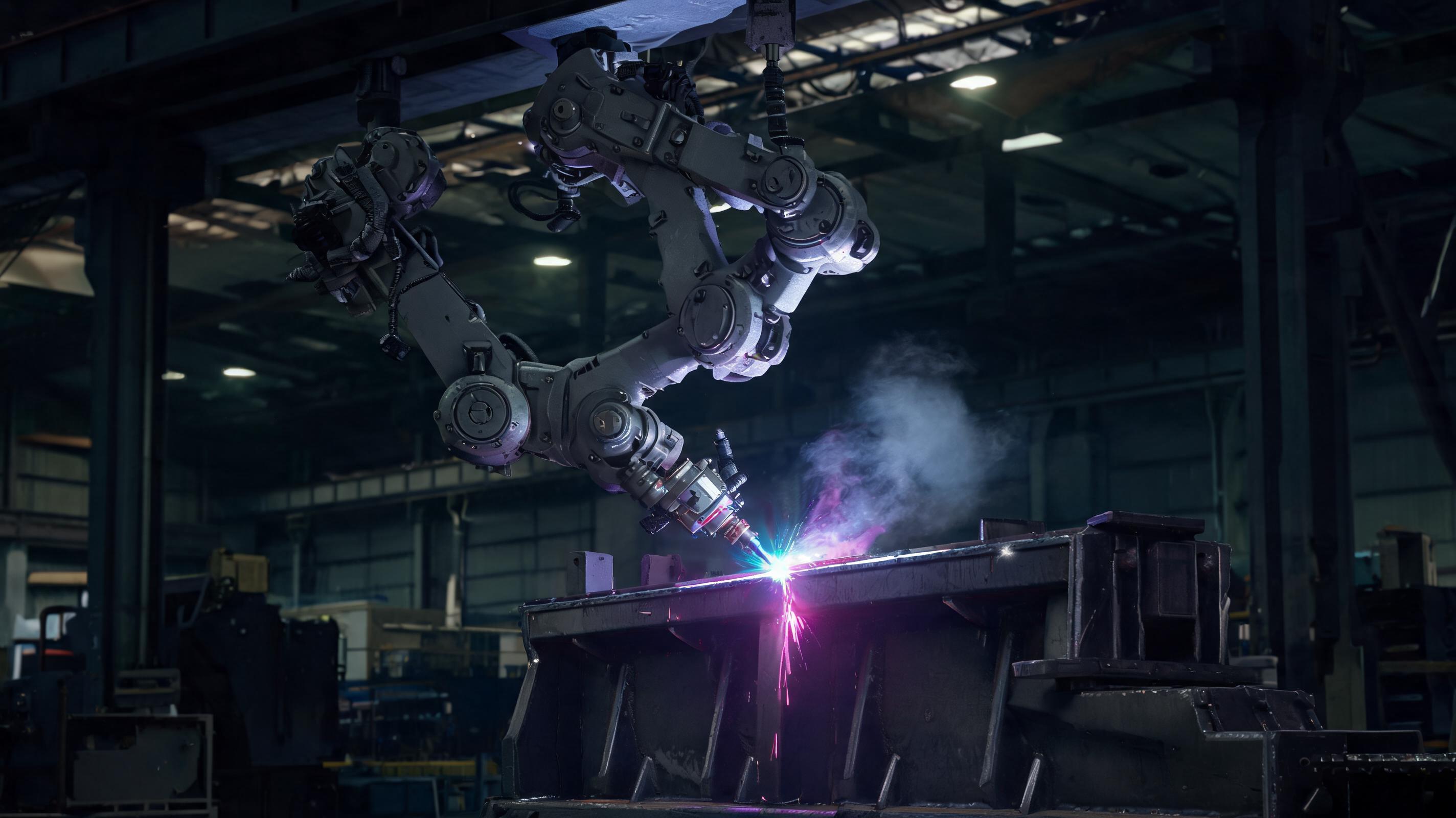
Shanghai Hugong Welding Group (SSE: 603131) has rolled out an 8-axis inverted intelligent no-teach welding robot aimed at heavy-industry welding in shipbuilding, steel structures, and construction machinery. Published October 10, 2026, the announcement targets a persistent pain point in heavy fabrication: complex welds on large structural parts, a shortage of skilled welders, and frequent changeovers between product variants.
No-teach programming raises changeover efficiency. Unlike conventional robots that require welders to teach points by hand, the system imports CAD models in formats such as STP, SPD, and CADWIN, then derives weld-seam identification, trajectory planning, and welding-parameter matching directly from the model data. Hugong says this cuts manual programming work and shortens setup time between different workpieces, improving the machine's fit for high-mix, low-batch welding tasks.
Intelligent deviation compensation adapts to real shop conditions. Large structural parts inevitably shift during cutting, assembly, and hoisting, so the robot supports roughly 30 mm of positional deviation compensation plus attitude-error correction, and can adaptively handle fillet-weld gaps within a defined range. By reconciling the difference between the actual workpiece position and the theoretical CAD model, the system reduces on-site manual adjustment and improves tolerance to messy, real-world welding conditions.
Welding process database improves quality consistency. Hugong pairs its established welding processes with intelligent control in a digital process database covering flat welding, vertical welding, multi-layer multi-pass groove welding, weaving, and corner-wrap techniques, with dedicated support for complex joints such as T-shaped stiffener plates, weld-access holes, and irregular lap joints. Digitally managed parameter calls reduce reliance on individual welders' experience and make process replication — and therefore weld-quality consistency — more dependable.
Eight-axis coordinated layout extends coverage on large structures. The inverted configuration adds external motion axes to a standard six-axis industrial robot: an X-direction floor rail works together with a Y-direction cantilever to widen the robot's working envelope across large ship blocks and structural sections. The overhead mounting also frees floor space, reducing interference with workpiece hoisting, transfer, and other on-site operations.
Toward human-robot collaboration. In production, the robot takes over repetitive, high-intensity welds while skilled welding staff concentrate on process management, quality control, and equipment maintenance — a division of labor Hugong positions as the practical path to welding automation upgrades in heavy industry. The company says it will keep pushing intelligent welding robots and automation solutions for shipbuilding, steel structure, construction machinery, and energy equipment customers, with the goal of raising efficiency, optimizing welding processes, and stabilizing welding capacity for manufacturers.