











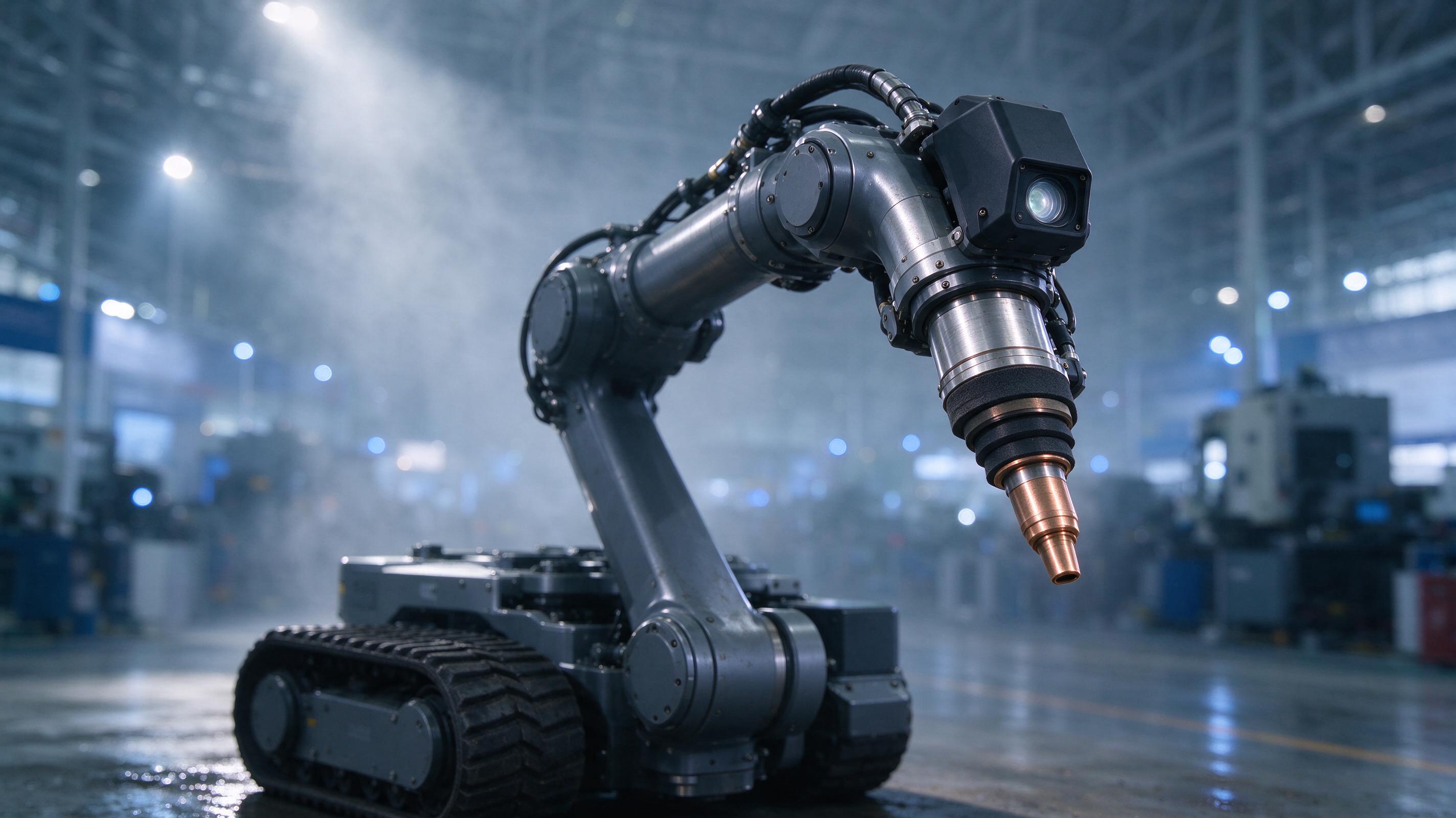
At the 2026 Tianjin International Welding & Cutting Exhibition, which opened on March 18 at the National Convention and Exhibition Center (Tianjin), Jiangsu Beiren — a leading embodied-intelligence robotics company based in Suzhou and listed on the STAR Market (688218.SH) — presented its mobile vehicle-mounted intelligent welding robot, a system built for heavy-industry welding across multiple scenarios.
The robot is designed for demanding working conditions such as heavy equipment manufacturing and large structural-part fabrication. Built on the company's self-developed welding process generation model and motion planning model, it senses changes in the workpiece, autonomously plans welding paths, and dynamically optimizes process parameters. Without tedious teach-and-playback programming, it can handle multi-variety, small-batch, and non-standardized welding tasks, helping manufacturers achieve flexible production and strengthen their market competitiveness.
The company positions the product as an effective replacement for manual labor: it reduces dependence on highly skilled welders, improves welding efficiency and consistency, and lowers overall costs. Its precise control and stable process lift weld quality, cutting scrap rates and rework while safeguarding product standards.
Four core capabilities underpin the system:
- Intelligent perception and decision-making — a laser vision system paired with proprietary algorithms precisely identifies weld seams, giving the robot the ability to "see" its environment clearly.
- Self-developed process generation model — based on massive amounts of data, it automatically generates optimal welding parameters and layer-and-pass planning, ensuring the robot "thinks" correctly.
- Self-developed motion planning model — it intelligently plans complex welding paths and adapts to a wide range of challenging conditions, keeping the mobile path accurate and error-free.
- High-level system integration — it integrates a flexible welding robot, a 3D vision system, and a digital welding power source, deeply fusing robot motion control with cutting-edge artificial intelligence to guarantee precise, stable task execution.
The exhibit reflects a broader trend in China's welding industry: the shift from teach-and-playback automation toward embodied, AI-driven systems that can adapt to unstructured, high-mix production. For heavy-equipment makers, where large weldments and small batches have long limited automation, a vehicle-mounted robot that perceives, plans, and welds on its own is a practical step toward flexible intelligent manufacturing.