










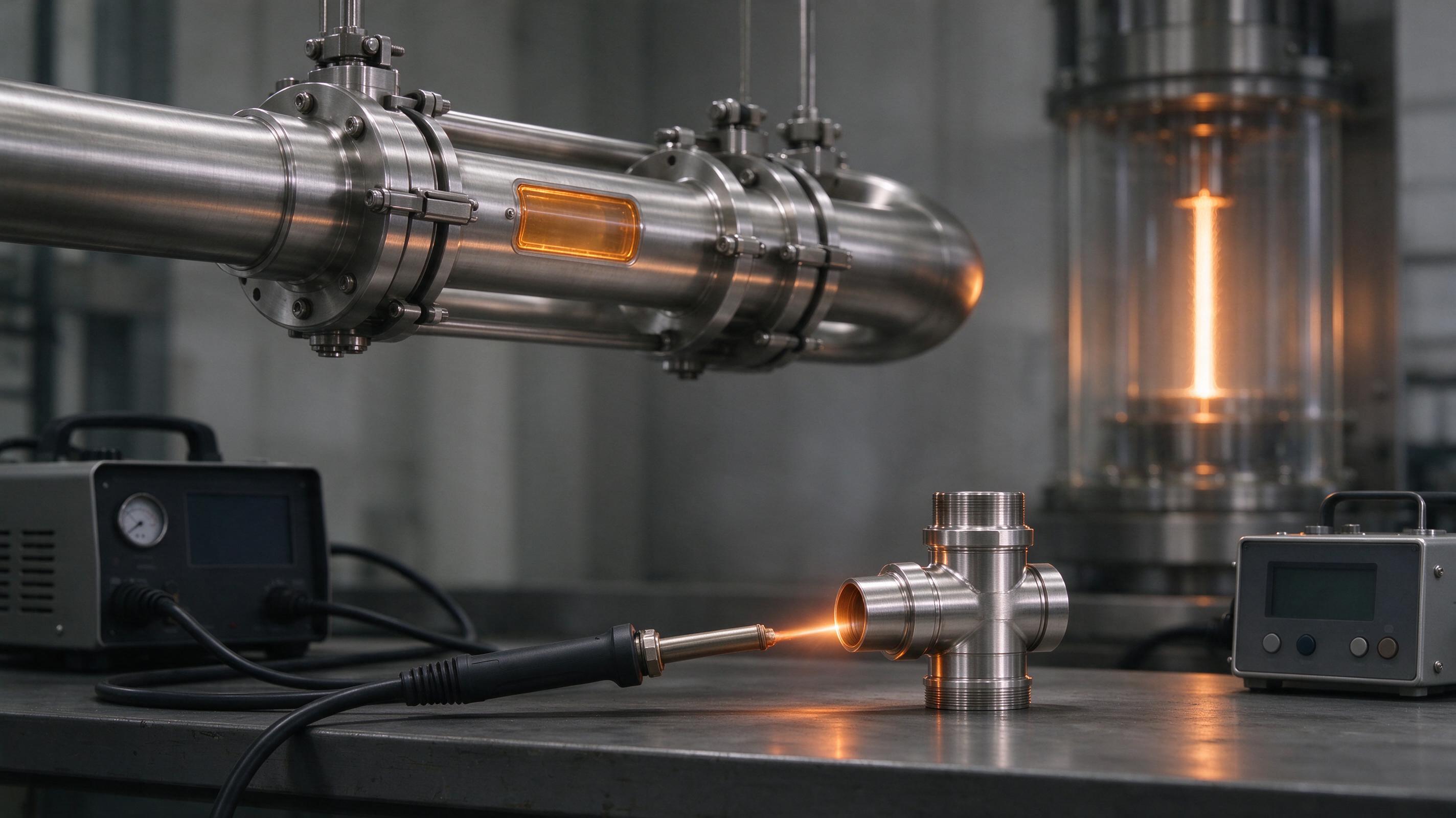
In a semiconductor fab, welding is one of the least conspicuous process steps. It never gets the attention that lithography precision earns, nor does it have the clear output rhythm of packaging and testing. But facility engineers know that gases, chemicals, precursors, and coolants all travel through these pipelines — and the condition of a weld's inner wall ultimately shows up in the yield report as particle counts and gas purity.
Why manual welding is falling short
Semiconductor process lines are typically built from high-purity electropolished 316L EP and VIM-VAR tubing and clean stainless pipe. Customers demand inner-wall roughness of Ra 0.4 micrometers or better, weld inner walls free of oxidation discoloration, and no chromium-depleted layer. These targets are unfriendly to manual welding: heat input depends on the operator's judgment, shielding-gas flow is adjusted by hand, and even the same welder produces quality fluctuations across different working states. Once oxidation tint or spatter residue appears on the inner wall, downstream cleaning can never fully remove the impact.
The pressure from production volume is even more concrete. Facility piping spans sizes from 1/4 inch up to 8 inches and beyond, with joint types covering tube-to-tube, tube-to-fitting, flanges, tees, and VMB/VMP assemblies. Every size change requires new fixtures and re-tuned parameters. Skilled orbital welders are already scarce, so capacity growth usually means adding people — which in turn makes weld-to-weld consistency even harder to control.
What automation actually changes
The core change is not simply "machines replacing people." It is decoupling weld quality from the operator's condition and handing it to programs and tooling for standardized control. Take the equipment lineup MeiWelding Technology (MeiHan Technology) is bringing to the show: the MWF series enclosed tube-to-tube welders serve thin-wall clean tubing from 3.17 mm to 219 mm diameter with four-channel high-purity argon protection, producing mirror-smooth, oxidation-free inner weld walls; they cover ultra-high-purity gas and chemical lines from DN6 to DN100 plus in-equipment EP tube assemblies. The MWHF fully automatic girth-welding machine extends the range to 10–500 mm and handles shaped girth welds on tees, elbows, and flanges; modular tooling turns changeover from "adjusting the machine" into "swapping the fixture," and in batch prefabrication the machines reach 3 to 5 times manual welding efficiency.
On-site installation is another typical scenario. The MWG open all-position tube-to-tube welder covers DN15–DN300 gas mains, vacuum lines, and cooling-water headers with multi-layer, multi-pass automatic fill — effectively controlling residual stress and distortion in thick-wall welds. For even larger diameters, a track-mounted welding carriage takes over, covering plant main lines from 273 mm to 1,422 mm with custom solutions not bound to fixed clamping sizes. In heat-exchange and cooling systems, the MWP all-position tube-to-tubesheet welder handles tube-sheet joints for heat exchangers, CDUs, manifolds, and cold plates; the MWH U-tube welder solves precision butt joints in small-radius bends; and the MWLD hot-wire cladding system applies corrosion-resistant inner-wall overlay for strongly corrosive chemical lines.
What the show floor can actually solve
Equipment specifications can be looked up anywhere, but whether a weld passes inspection, how long a changeover takes, and how wide the process window is usually require hands-on validation with real workpieces. From November 12 to 14 at the China International Semiconductor Expo (IC China 2026) in Beijing, MeiWelding Technology will be at booth B020 in the National Convention Center, working through representative workpieces — UHP gas mains and secondary piping, gas cabinets and VMB/VMP assemblies, precursor and wet-chemical lines, CMP slurry lines, vacuum and cooling-water circuits, CDU/manifold assemblies, and in-equipment EP tube components — with condition assessment, process case studies, live equipment demonstrations, and one-on-one technical consultation. Bringing drawings and inspection reports to the booth is worth far more than reading a brochure.
The answers to all three questions point to the same industry trend: welding of semiconductor ultra-high-purity pipelines is shifting from experience-dependent "hand craft" toward a recordable, reusable, standardized "manufacturing process" — which is exactly why welding equipment deserves standalone attention at this year's show.